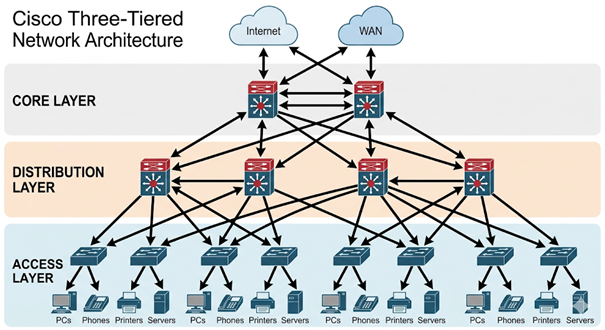
The three-tiered architecture was built by Cisco and it still holds up. The basic thing is, you have three layers and that every time.
- The Access Layer: the name says it all, basically this layer where the devices ACCESS the network
- The distribution layer: it’s like the connection point of everything “more important” if you will. Your access layer switches don’t connect to each other, they connect up to the distribution layer. At this layer live our important servers (DNS, DHCP) as well. And what we learned before; redundancy is a big point, so EVERY access layer switch connects to EVERY distribution switch!
- The core layer: the core layer is like the consolidation point if you want to connect two or more buildings. In the beginning of building that network (with like two buildings) you think your core layer is obsolete, but as soon as you connect 5 buildings and each building has 4 distribution switches you realize the meaning of the core layer. Instead of connecting each distribution switch to each other, you implement the core layer and connect every distribution switch to it.
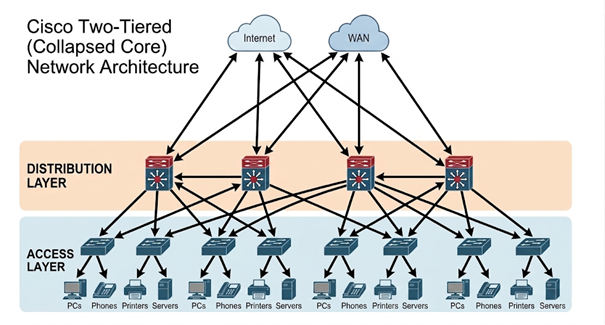
Two tiers vs. three tiers
There is another architecture model which is the two-tiered architecture model. The rule is simple: One or two buildings -> use the two-tier model (collapsed core model).
Because the core layer is collapsed into distribution.
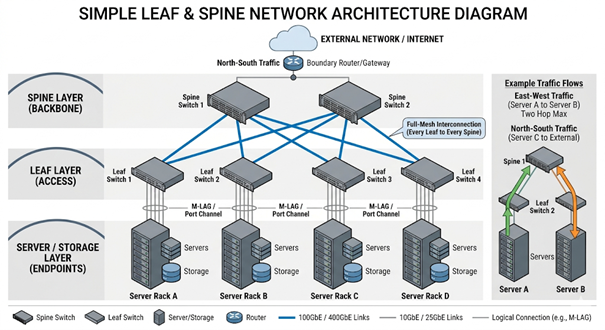
Spine and Leaf
This model is only used in data centers. Leaf switches connect to spine switches in a rack.